


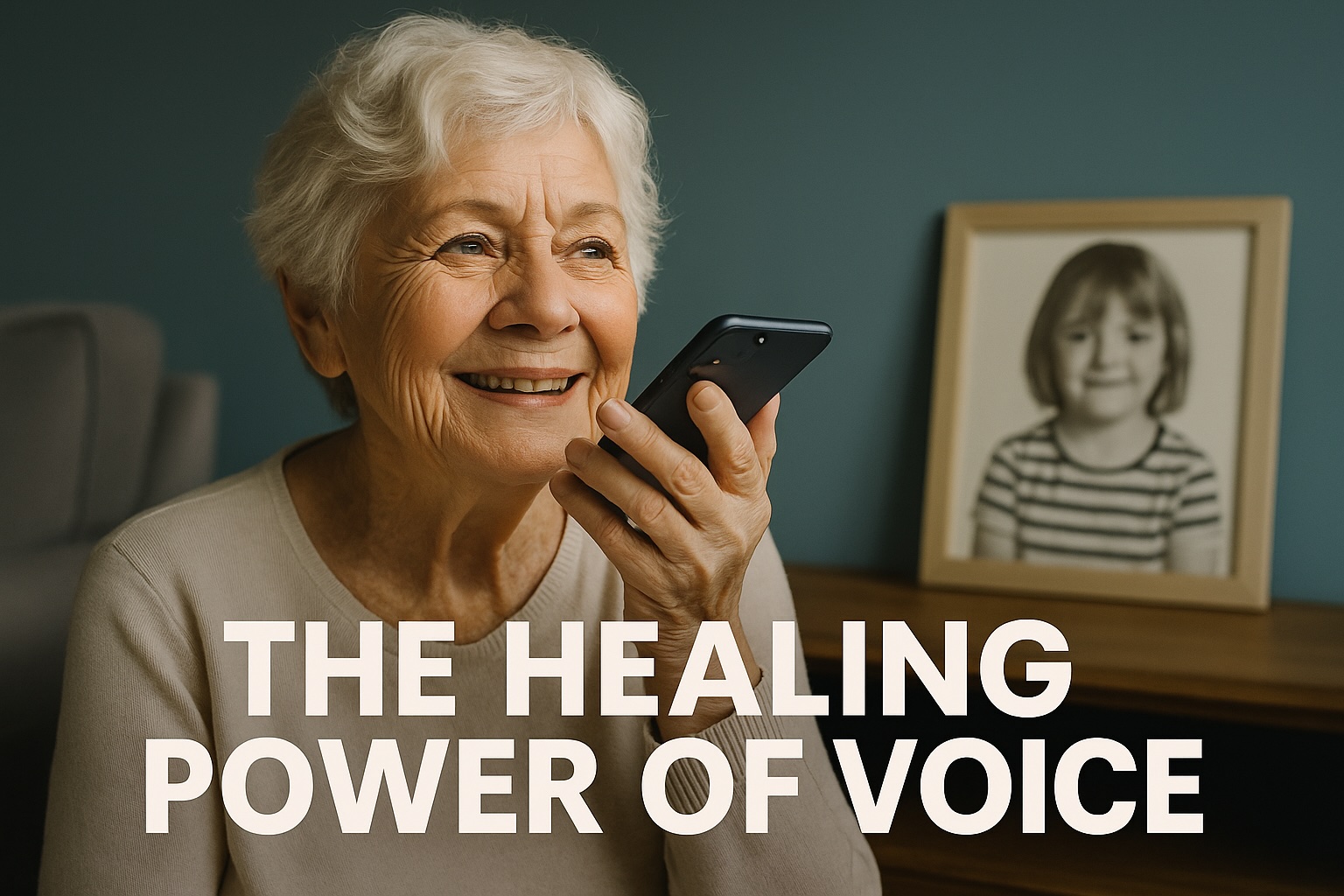
I realized the true power of voice when my friend’s mother temporarily lost hers after a fall. The thought hit me hard – if she lost her voice permanently, all of her stories would vanish forever.
That moment changed a lot for me.
Voice is our first connection to the world. Before we see, we hear – our mother’s heartbeat, her voice filtering through the womb, her soothing words as we cry.
This primal connection to voice makes it uniquely powerful for patients in nursing and hospice care.
When someone enters end-of-life care, voice often fades first. Stories disappear. Family connections weaken. But what if we could preserve those voices and stories before they’re lost?
The Voice-Memory Connection
Voice carries something photos and written words simply cannot – implicit trust. When we hear a loved one’s voice, something deep within us recognizes and trusts it immediately.
This trust creates powerful possibilities for patients with memory conditions.
Research shows that hearing familiar voices can trigger memories in patients with dementia, with personalized audio content providing stronger emotional connections than generic content.
I’m exploring how we might “prep” someone with dementia before family visits by having them listen to recordings of their loved one’s voice and stories.
Imagine a grandmother with dementia who struggles to recognize her grandson. Before his visit, she listens to his voice sharing memories they created together. By the time he arrives, those neural pathways have been gently awakened.
The visit becomes meaningful rather than confusing or distressing.
Beyond Memory: Voice as Therapy
Voice preservation serves as more than just memory – it becomes active therapy for both patients and families.
For patients, telling their stories gives purpose. It validates that their life matters, that their experiences deserve to be remembered.
For families left behind, these voice recordings create what I call the “greatest hits” of someone’s life. Rather than scattered memories or photos, AI can compile a 10-minute essence of who someone truly was – in their own words and voice.
This replaces the unreliable “telephone game” of family history with something authentic.
Studies show that digital storytelling participants experience therapeutic benefits, noting it “felt good to talk about the topic” and gave them opportunities to reflect on experiences in new ways.
Simple Technology, Profound Impact
The beauty is that implementing this doesn’t require complex technology. A smartphone or computer with a built-in microphone is all that’s needed.
Our application allows nursing home staff or family members to conduct interviews, preserve stories, and even clone voices for future interaction.
What makes this particularly valuable for patients with limited communication abilities is that they don’t need to speak to benefit. They can simply press on photos to hear stories, or select questions to prompt the AI to share memories previously recorded.
The repetitive nature of these stories becomes a feature, not a bug. As memory fades, hearing the same beloved story feels new each time.
The Ethical Foundation
Privacy and consent form the bedrock of ethical voice preservation. Just as museums obtain family consent to use Salvador Dalí’s voice or sports broadcasts use Jim Fagin’s, proper permission must be secured.
This means getting consent from the person themselves while able, or from whoever holds power of attorney later.
The focus remains on preservation, connection, and dignity – not technology for technology’s sake.
Voice as the Bookend of Life
Voice is the first thing we hear when entering this world and often the last thing we experience when leaving it. This symmetry feels meaningful.
When someone can no longer speak – not from physical limitations but from deeper unconsciousness – something fundamental seems missing. Part of their essence has departed.
But what if we could give voice back to those who have lost it?
For someone who loses their voice to stroke late in life, having previously preserved their vocal patterns means they could potentially communicate using their actual voice rather than a generic robotic one.
The technology exists to connect voice synthesis to brain implants, allowing thoughts to become spoken words in one’s own voice – but only if we’ve preserved that voice beforehand.
This requires foresight. We must capture voices before they’re lost.
Building Bridges Across Time
The resistance I sometimes encounter when discussing voice preservation often stems from privacy concerns. People worry about having words put in their mouths.
I understand this hesitation. Any technology can be misused.
But I gently remind them that preserving stories doesn’t necessarily require voice cloning. The stories themselves are the primary treasure we’re safeguarding.
Voice is simply the most emotionally resonant vehicle for those stories.
In nursing homes and hospice care, these preserved voices become bridges – connecting patients to their families, to their own histories, and to a sense that they matter.
They transform isolation into connection.
They turn forgetting into remembering.
They make the end of life not just about loss, but about legacy.
All through the healing power of voice.