


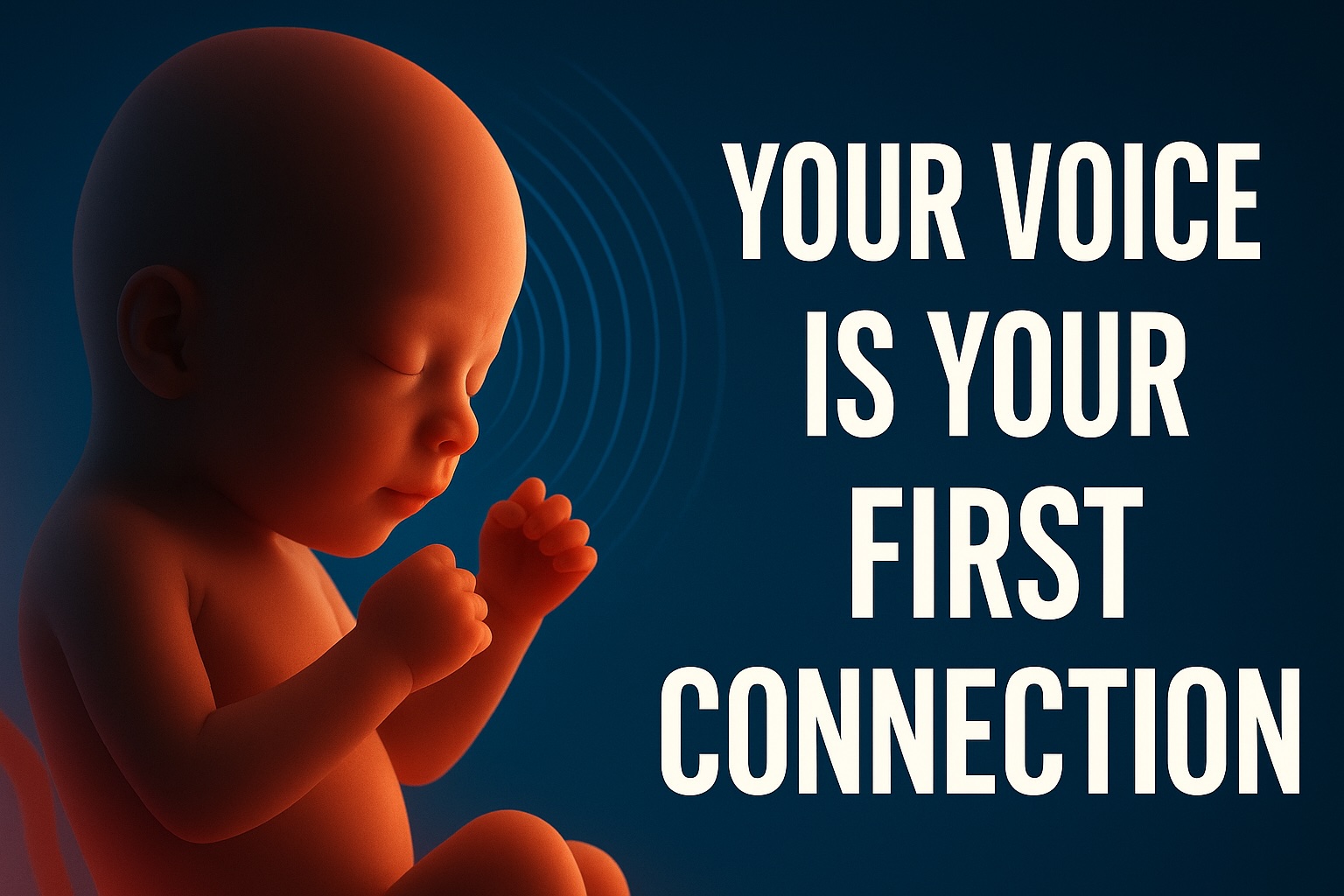
Your voice was heard before your face was seen.
This isn’t metaphorical—it’s a biological fact. While still in the womb, we begin responding to sound at around 16 weeks, with consistent responses developing between 22-24 weeks. Long before we open our eyes to the world, we’re already forming connections through sound—particularly through voice.
Research confirms that fetuses can recognize their mother’s voice before birth. This recognition manifests physically: fetal heart rates increase in response to maternal voices and decrease when hearing strangers. Our relationship with voice begins before our first breath.
I’ve spent years exploring the intersection of audio and human connection, and I’ve become convinced that voice represents our most fundamental sensory bridge to others. It’s also potentially our most powerful legacy technology.
Why Voice Forms Our Deepest Connections
Voice carries something beyond information. It transmits identity and emotion in ways that text cannot replicate.
Consider how instantly you recognize a loved one’s voice on the phone. No introduction needed. This happens because each voice contains distinctive characteristics creating what’s essentially a voiceprint as unique as fingerprints. Your voice is your sonic signature.
But voice does more than identify—it connects.
Studies show that emotionally expressive voices create stronger memories than neutral ones, even after just a single exposure. This enhanced recall remains significant when tested a week later. Our brains are wired to remember voices that carry emotional resonance.
This explains why hearing a grandparent’s voice telling a family story creates more lasting impact than reading the same story as text. The emotional texture of voice embeds the narrative more deeply in memory.
The Disappearing Voices Problem
Despite voice’s power, we’ve historically done a poor job preserving it.
Family photographs date back generations, but voice recordings of ordinary people remain relatively rare before the late 20th century.
Even today, while we capture countless images and text messages, systematic voice preservation isn’t common practice in most families.
This creates a profound legacy gap. We can see our ancestors but cannot hear them.
The implications extend beyond nostalgia. Without voice, we lose the emotional resonance that strengthens memory transmission across generations. We lose the unique cadence, accent, and vocal expressions that carried family wisdom.
I believe this represents one of our most significant yet unrecognized cultural losses.
Voice as Legacy Technology
Technology now offers unprecedented possibilities for voice preservation and transmission.
The same AI advances that have raised concerns in some contexts offer transformative potential for family legacy. Voice cloning technology, applied ethically and with consent, creates opportunities to preserve not just what was said, but how it was said—with all the emotional texture intact.
Interactive family trees based on voice recordings can transform static genealogy into living history. Imagine not just seeing your great-grandmother’s name on a family tree but hearing her tell the story of her immigration journey in her own voice.
The technology exists today to create these connections. The challenge isn’t technical—it’s awareness.
Beyond Recording to Interaction
The future extends beyond simple recording to interactive possibilities.
Voice-based AI agents trained on family stories and wisdom could allow future generations to “converse” with ancestors. Children could ask questions and receive responses that maintain the authentic voice and perspective of family members who recorded their stories.
Unlike public AI systems trained on generic data, these family-specific voice archives would preserve the unique expressions, sayings, and wisdom particular to your family history.
This isn’t about creating artificial versions of loved ones. It’s about preserving authentic voice and story in formats that future generations can meaningfully engage with.
The Voice Preservation Imperative
If voice is indeed our first and most emotionally resonant connection, then its preservation becomes a cultural imperative.
Every family has a designated memory keeper—the person who preserves photos, maintains the family tree, and collects stories. Increasingly, this role must expand to include voice preservation.
The technology to do this is becoming more accessible. Voice recording no longer requires professional equipment, and AI tools for organizing and preserving these recordings are increasingly available to everyday people.
What’s needed is a shift in perspective—recognizing voice not just as ephemeral communication but as precious legacy technology that predates all our digital innovations.
Our voices connected us to our mothers before birth. They may also be what best connects us to generations yet unborn.